14 Facts About Galway That Will Surprise You
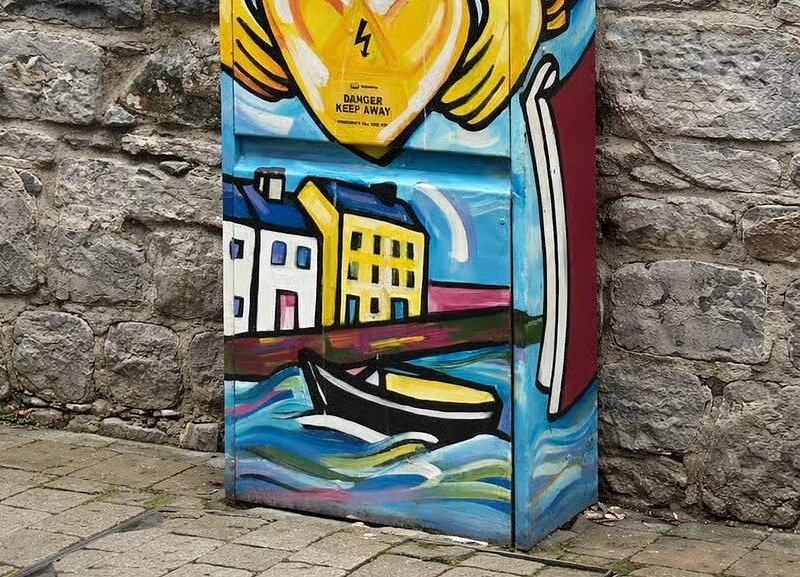
The short answer. Fourteen merchant families ran this town for four hundred years, a thirteenth-century hall sits under a modern office floor with 11,000 artefacts recovered from it, the cathedral is the youngest great stone cathedral in Europe, and the parish church has been in continuous use since 1320. Most of it is free to go and look at.
Galway wears its history lightly, which is why you will walk past most of it without noticing. These are the fourteen that surprise people most, and almost all of them sit on the route the Galway walking tours already take. You can see nine of them in an afternoon.
1. Fourteen families ran the town, and their names are the street signs
The Tribes of Galway — Lynch, Blake, Browne, Joyce, Martin, Kirwan and eight more — held the walled town for centuries. You do not need a museum to meet them: Kirwan's Lane, Lynch's Castle and the Browne Doorway are all on one walk.
2. There is a thirteenth-century hall under an office floor
The Hall of the Red Earl was found in 1997 by Office of Public Works archaeologists when an extension to the adjoining offices was proposed. Over 11,000 artefacts came out of the dig. It is open Monday to Friday and free.
3. The cathedral is younger than the Beatles
The Cathedral of Our Lady Assumed into Heaven and St Nicholas was dedicated on 15 August 1965. It describes itself as the youngest of Europe's great stone cathedrals, and it is built of limestone in a style four hundred years older than its date.
4. The parish church has not closed since 1320
St Nicholas' Collegiate Church was completed in that year on a site already used for worship, and it has been in continuous use ever since. Its own account says Christopher Columbus prayed there — the church's tradition rather than settled history, and a good story either way.
5. The Claddagh had its own king
The fishing village across the river from the walled town kept its own customs, its own Irish-speaking community and an elected king who settled disputes and led the fleet. The ring that carries its name came from there, and one shop on Quay Street has been selling it since the eighteenth century.
6. The Cliffs of Moher are older than the Atlantic view suggests
The rock was laid down over 320 million years ago, and the cliffs run almost fourteen kilometres — eight miles — along the Clare coast. They stand over seven hundred feet high at O'Brien's Tower.
7. The tower was built for tourists in 1835
Sir Cornelius O'Brien, the local landlord and member of parliament, put it up as an observation point for the visitors already coming to see the cliffs. Tourism at the Cliffs of Moher is therefore older than most of the hotels in Galway.
8. Over 30,000 pairs of seabirds nest on that wall
The cliffs are a Special Protection Area for birds, and in the nesting season the numbers are counted in tens of thousands of pairs. Fulmars, peregrine falcons, choughs and ravens stay all winter. The visitor centre lends binoculars free.
9. The Burren and the cliffs are one place, officially
Both sit inside the Burren and Cliffs of Moher UNESCO Global Geopark. That is why every day trip stops on the way rather than driving straight there — it is one landscape, not two. The detail is on the Cliffs of Moher page.
10. Poulnabrone Dolmen stands on bare rock, and nobody charges for it
Poulnabrone Dolmen is a portal tomb on the limestone pavement, thousands of years old, with a car park and no gate. One day trip stops there for twenty minutes, and it is the only stop of its kind on any of these routes.
11. Every island day goes to the smallest island
Inis Oírr, not Inis Mór. It is fifteen minutes from Doolin against thirty-five to the big island, and it holds a shipwreck, a tower house and a beach within a mile of the pier. Which is which is set out on the Aran Islands page.
12. A ship has been sitting on the rocks of Inis Oírr for decades
The Plassey was driven ashore in a storm and left where it landed. Its plating is red with rust and its hull is open to the weather, and it is a ten-minute walk or a short cycle from the pier.
13. Irish is the working language a few miles west
Connemara holds one of the largest Gaeltacht districts in the country, and the road out through Barna and Spiddal runs straight into it. Signs change language, shopkeepers switch mid-sentence, and no tour asks you to speak a word of it.
14. The city doubles in size for a fortnight every July
The Arts Festival runs from 13 to 26 July in 2026, and the Races at Ballybrit take eight consecutive days at the end of the month. Beds go months ahead and day-trip seats go with them. Both are listed on things to do in Galway.
| Fact | Where | What it costs |
|---|---|---|
| The Hall of the Red Earl | Druid Lane, off Quay Street | Free, weekdays |
| St Nicholas' Collegiate Church | Lombard Street | Ask at the door |
| Galway Cathedral | Across the Salmon Weir Bridge | €3 requested |
| Galway City Museum | Spanish Parade | Free, €5 suggested |
| Poulnabrone Dolmen | The Burren, County Clare | Nothing |
| The Cliffs of Moher | County Clare, 90 minutes south | €8 adult, free under 12 |
| The Plassey | Inis Oírr, 15 minutes from Doolin | Nothing, once you are there |
How to see nine of them in one afternoon
Start at Eyre Square with the Browne Doorway, walk down Shop Street to Lynch's Castle, and turn off to St Nicholas' church. From there you are five minutes from the Hall of the Red Earl on Druid Lane, and five more from the Spanish Arch and the museum. Cross the water for the Claddagh and the Long Walk, then climb back up to the cathedral.
That is nine of the fourteen in about three hours if you stop properly, and you will pay nothing except the €3 the cathedral asks and the €5 the museum suggests. The other five are in County Clare and on Inis Oírr, and you need a day trip for those.
Where to hear the rest of it
Facts read cold are a list. On a guided walk you get them with the building in front of you, which is a different thing entirely — and the mythology route in particular is built around the stories rather than the dates. If you would rather cover ground than stand still, the open-top bus gives you the same names at thirteen stops.
Want the stories with the stones? Every guided route is compared on Galway Ireland Tours, with what each one stops at and how long it takes.
Tours that cover this ground
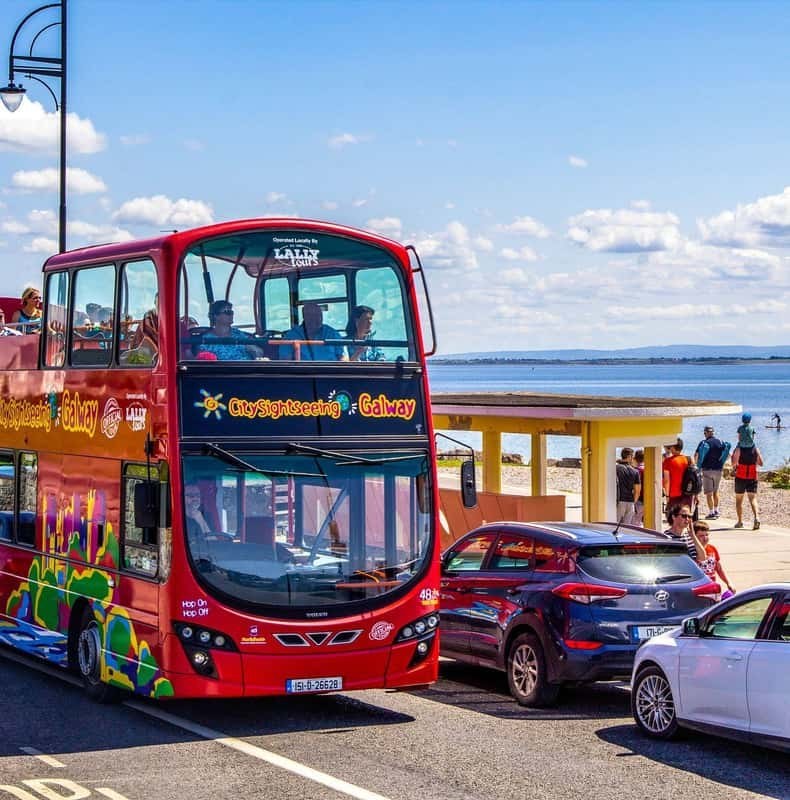
Galway: City Sightseeing Hop-On Hop-Off Bus Tour
Thirteen stops on an open-top bus, valid twenty-four or forty-eight hours, and the answer when walking is hard going.
From $24 per person
Check Availability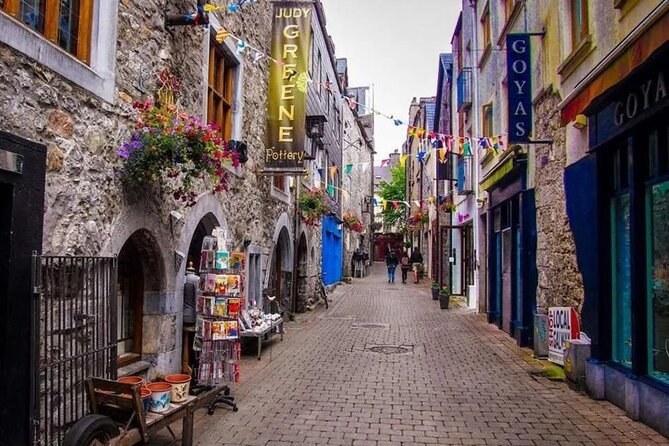
Walking and Tasting Tour of Galway City
Nine stops in two and a half hours with the history and the food together, afternoon or evening.
From $82 per person
Check Availability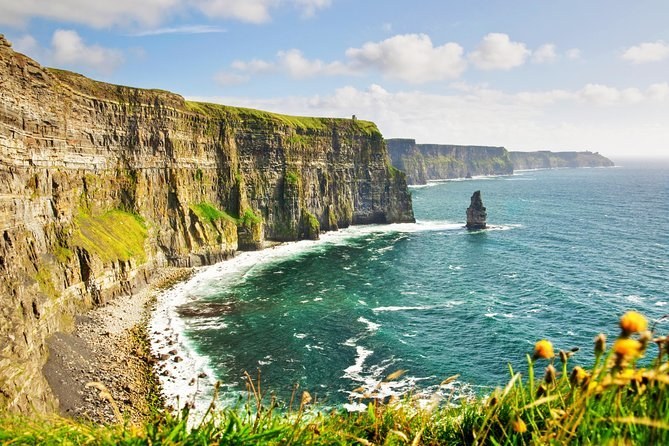
Galway to Cliffs of Moher, Aillwee Cave & Dunguaire Castle Tour
Four stops on the Clare road with free hotel pick-up, and a coach that is smaller than the fare suggests.
From $76 per person
Check Availability